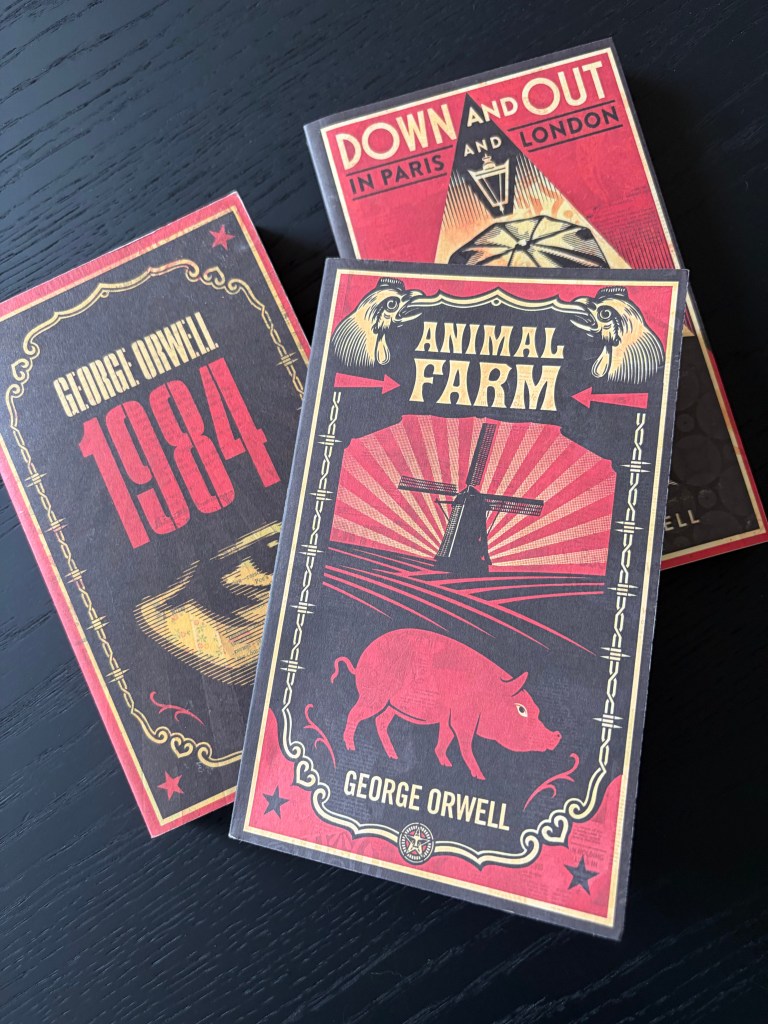
- Author: George Orwell
- Publisher: Penguin Random House UK
- Publishing year: 2008 (originally 1945)
- Pages: 95
- Coverdesign: Shepard Faircy
- ISBN: 978-0141036137
https://www.penguin.co.uk/books/57033/animal-farm-by-orwell-george/9780241453865
Review:
All animals are equal but…
When your bff’s son has to read a classic, in English, for a school assignment and it’s a book you absolutely love and read it when you were about his age, 16, you realize it’s time you reread it. Under the guise of ‘wanting to help him out’, I decided to pick it up and absolutely devoured it in one sitting. This book is an absolute must-read. Oh and yes, this book is a banned book so it’s most definitely a must-read then! Why is it banned? In certain countries (China, Russia, Cuba), because it criticizes communism. In the United States it is banned in certain school libraries because, according to parents and school boards, it idolizes communism. So depending on where you are and on which side of the medallion, there’s always a reason to find to ban a book that has absolutely no reason to be banned.
Animal Farm was published in 1945, shortly after the second World War (it was written during the war) and after the defeat of Hitler and his Nazi party. In it, Orwell draws an allegory with the rise of communism by having animals revolt against their masters, the farmers. Under the guidance of the pigs, the animal revolution breaks out and they are victorious over Man. Shortly after, the name of the farm, Manor Farm, changes into Animal Farm. All animals are bound by seven commandments they should live by:
The Seven Commandments
- Whatever goes upon two legs is an enemy.
- Whatever goes upon four legs, or has wings, is a friend.
- No animal shall wear clothes.
- No animal shall sleep in a bed.
- No animal shall drink alcohol.
- No animal shall kill any other animal.
- All animals are equal.
Two of the pigs, Napoleon and Snowball, take reign of the farm but both start to disagree on how to proceed. This ultimately leads to Snowball’s banishment from the farm. Snowball is never heard from again afterwards. Life on the farm becomes extremely hard for the animals. Not only do they have to fight the humans who destroy everything they try to build, but also Napoleon becomes more and more of a dictator, and with a pack of savage dogs he trained, he rules with a very hard hand. And the more the pigs start to get the upper hand on the farm, the more the commandments change so far so that ‘All animals are equal, but some are more equal than others’!
This book is a clear allegory for the events after the Russian revolution, under the leadership of Stalin. Napoleon is the embodiment of Stalin in this novel, and Snowball is Trotski (who helped win the October revolution, and who created the Red Army, but eventually rose up against Stalin which got him banished and murdered – sound familiar?). Adolf Hitler is represented in the farmer who gets chased away from his farm, so his part is only a small one in the novel and unsignificant, apart from the fact that the animals (the Russian people) conquered the farm (helped overcome Nazi Germany).
Even though this book was written and published over eighty years ago, it feels very familiar and not very far from the current situation. Hence probably why a lot of countries are banning it from libraries, it confronts them too much with a reality not too far off the current one. Such a pity, honestly. So as a wise man once said: ‘Read banned books’! That is the best advice one can give to anyone who is willing to broaden their mind.


Geef een reactie