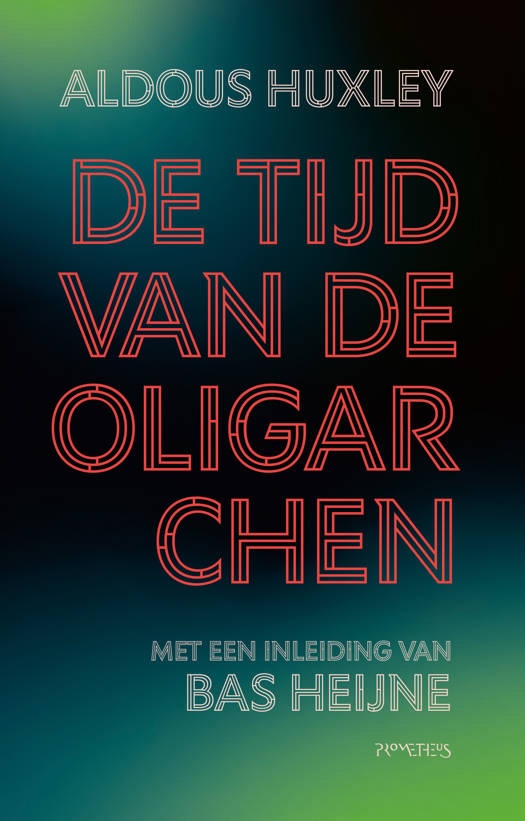
Over technologie, vrijheid en vrede
- Auteur: Aldous Huxley
- Voorwoord: Bas Heijne
- Uitgeverij: Uitgeverij Prometheus / LM Books
- Jaar uitgave: 2026
- Pagina’s: 110
- Coverontwerp: CMRB
- Originele titel: Time of the Oligarchs (1946)
- Vertaling: Thomas Heij
- ISBN: 978-9044661873
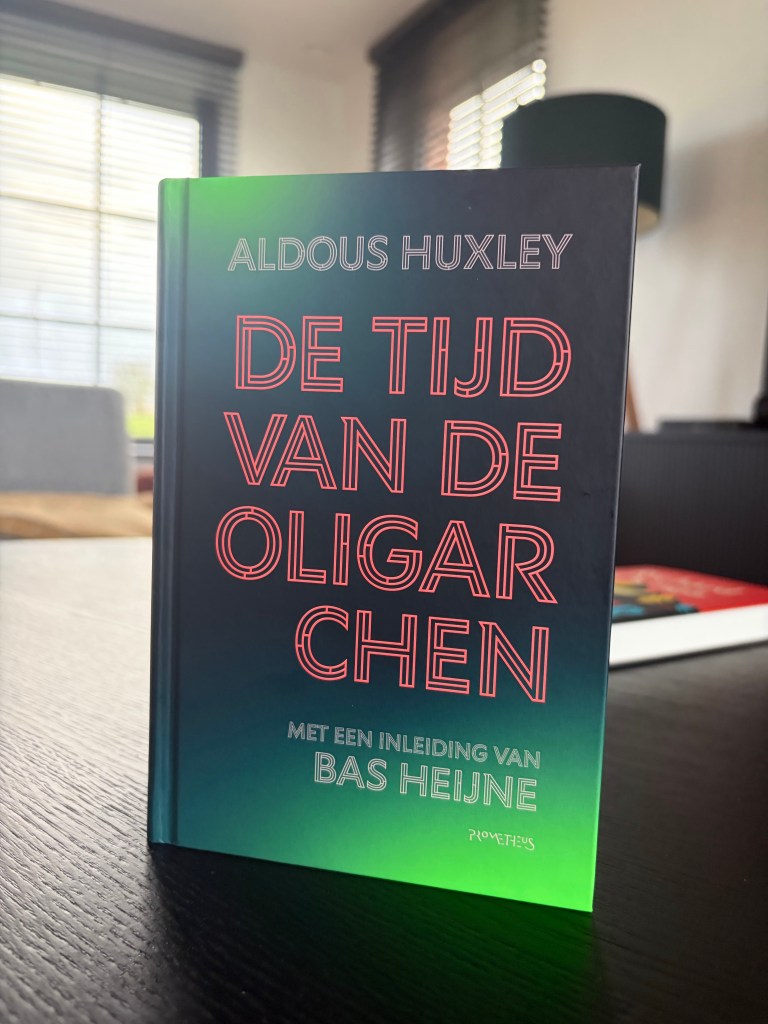
https://uitgeverijprometheus.nl/boeken/tijd-van-de-oligarchen-gebonden/
Review:
A Brave new/old Book
Aldous Huxley is een naam die bekend is door zijn dystopische roman ‘A Brave new World’, gepubliceerd in 1932. Samen met George Orwell’s 1984 (Big Brother is watching you) één van de belangrijkste boeken uit het interbellum waarin de Eerste Wereldoorlog nog in nazindert maar waarin vooral de opkomst en misbruik van sociale hiërarchie, door middel van nieuwe technologieën, een grote rol spelen. (Het is van mijn tienerjaren geleden dat ik beide boeken las dus deze eens herlezen zou zeker geen slecht idee zijn).
Dit essay, De tijd van de Oligarchen, schreef Huxley net na de Tweede Wereldoorlog in 1946, maar als je dit leest zou het evengoed vandaag kunnen geschreven en gepubliceerd zijn. Dat kan enerzijds betekenen dat Huxley een visionair was maar ik vrees dat het gewoon betekent dat de geschiedenis de neiging heeft om zich te herhalen. In het essay gaat Huxley dieper in over thema’s dat ook in zijn boek ‘A Brave new World’ voorkomen, namelijk de opkomst van technologische vooruitgang op vlak van wapens en manieren om de medemens te onderdrukken aan de hand van een politieke structuur waarbij nationalisme en geopolitieke machtsspelletjes door een kleine minderheid worden gehanteerd.
In onderstaande quote uit het boek is ook duidelijk dat volgens Huxley, maar de praktijk leert dat dit ook echt de realiteit is, de ‘grote bonzen’ (zoals hij ze noemt) een grote tekortkoming hebben:
“De collectieve mentaliteit van naties – de mentaliteit die redelijke volwassenen moeten aannemen wanneer ze belangrijke beslissingen nemen op het gebied van internationale politiek – is die van een veertienjarige delinquent, tegelijkertijd sluw en kinderachtig, kwaadaardig en dwaas, waanzinnig, egoïstisch, lichtgeraakt en hebzuchtig, en tegelijkertijd belachelijk verwaand en ijdel.”
Als ik deze quote las moest ik onmiddellijk denken aan de huidige Amerikaanse president (maar ook aan andere tirannieke leiders natuurlijk) die een mooi voorbeeld is van wat Huxley hier beschreef.
Wat me dan ook weer opviel in dit essay is hoe het klimaatprobleem in het midden van de 20ste eeuw dan weer geen onderwerp van discussie was. Toen stond men daar duidelijk niet bij stil en werd gekeken, door Huxley in dit geval maar vermoedelijk algemeen door iedereen, naar heropbouw en vooruitgang, vooral op vlak van agricultuur en industrie. Er werd niet bij stilgestaan welke gevolgen dit zou hebben op lange termijn.
Ook al weet men dat het essay, dat een jaar na het einde van een destructieve oorlog werd geschreven, verwijzen kan naar Adolf Hitler, het mag duidelijk zijn dat een dergelijk leiderschap van alle tijden is. De middelen zijn anders maar de methoden blijven allemaal hetzelfde. En het kleinzerige gedrag van dergelijke leiders verandert duidelijk ook niet.
Vandaar dat ik dit essay ook met ongelofelijk veel aandacht heb gelezen. Het is herkenbaar, het is intrigerend en interessant en vooral toont het aan dat geschiedenis zich niet enkel herhaalt maar dat men ook niet leert uit voorgaande polariserende taal en leiderschap. Dit essay mag dan misschien tachtig jaar geleden geschreven geweest zijn, het is tot op de dag van vandaag nog heel relevant en ik vrees dat we nog eens tachtig jaar later hetzelfde zullen moeten concluderen.
Bas Heijne, Nederlands schrijver en essayist, schreef voor de herdruk van dit essay een voorwoord waarin ook hij het vergelijk legt met de huidige politieke spanning en de manier waarop de Verenigde Staten aan politiek doet, onder andere door zelf een beetje ‘Big Brother’ te willen spelen en mensen die momenteel naar het land willen reizen volledig gescreend worden, zelfs de sociale media wordt nagekeken of er posts werden gedaan die tegen het huidige regime ingaan. En ja, daardoor zou men zelfs geweigerd kunnen worden het land binnen te komen. (Ik vermoed dat ik zeker niet binnen mag met de meningen die ik al heb geuit! De vraag is: wil ik dat wel?)
Kortom, ‘De Tijd van de Oligarchen’ is een heel tijdloos essay dat de tand des tijds doorstaat (jammer genoeg) en dat eigenlijk best vandaag ook nog meer zou mogen (moeten?) gelezen worden.
English:
Time of the Oligarchs
Science, Liberty and Peace
Review:
A Brave new/old Book
Aldous Huxley is a name known for his dystopian novel Brave New World, published in 1932. Together with George Orwell’s 1984 (“Big Brother is watching you”), it is one of the most important books from the interwar period, in which the First World War still echoes, but where the rise and abuse of social hierarchy through new technologies play a central role. (It has been since my teenage years that I read both books, so rereading them would certainly not be a bad idea.)
Huxley wrote this essay, The Age of the Oligarchs, just after the Second World War in 1946, yet when you read it, it could just as easily have been written and published today. On the one hand, that might mean Huxley was a visionary, but I fear it simply means that history has a tendency to repeat itself. In the essay, Huxley explores themes that also appear in his book Brave New World: the rise of technological advances in weaponry and methods of oppressing others, supported by a political structure in which nationalism and geopolitical power games are manipulated by a small minority.
In the quote below from the book, it is also clear that, according to Huxley—and practice shows that this is indeed reality—the “big bosses” (as he calls them) have a major shortcoming:
“The collective mentality of nations—the mentality that reasonable adults must adopt when making important decisions in the field of international politics—is that of a delinquent fourteen-year-old, at once cunning and childish, malicious and foolish, insane, selfish, touchy, and greedy, and at the same time ridiculously vain and conceited.”
When I read this quote, I immediately thought of the current American president (but of course also of other tyrannical leaders), who is a clear example of what Huxley described here.
What also struck me in this essay is how climate change was not a topic of discussion in the mid-20th century. At that time, people clearly did not dwell on it and focused instead—Huxley in this case, but presumably society in general—on reconstruction and progress, especially in the fields of agriculture and industry. There was little consideration of the long-term consequences this would have.
Although one knows that the essay, written a year after the end of a destructive war, may refer to Adolf Hitler, it should be clear that such leadership exists in every era. The tools may differ, but the methods remain the same. And the petty behavior of such leaders clearly does not change either.
That is why I read this essay with an incredible amount of attention. It is recognizable, intriguing, and interesting, and above all it shows that history not only repeats itself, but that people also fail to learn from previous polarizing language and leadership. The essay may have been written eighty years ago, yet to this day it remains highly relevant—and I fear that eighty years from now we will have to draw the same conclusion.
Bas Heijne, Dutch writer and essayist, wrote a foreword for the reissue of this essay in which he also draws parallels with current political tensions and the way the United States conducts politics, including its desire to play a kind of “Big Brother” by fully screening people who wish to travel to the country—checking even social media to see whether posts have been made that go against the current regime. And yes, this could even result in being denied entry to the country. (I suspect I certainly wouldn’t be allowed in, given the opinions I have already expressed! The question is: would I even want to?)
In short, The Age of the Oligarchs is a highly timeless essay that withstands the test of time (unfortunately) and that truly deserves to be read more widely today as well—perhaps even ought to be.
 Looneybooks79
Plaats een reactie